Nightly
No. 73Thursday, 24 September 20264 min read

Thu 24 Sept

You’re reading an archived edition. Today’s is here →

Top picks

read these, skip the rest
Top pickResearcharXiv cs.CL

The Agent-Editing World Model (AEWM) treats reasoning and actions as the drivers of future task progress, adding an Action Judge to classify decisions and a State Revision module to edit noisy continuations.

AEWM addresses task‑state contamination, where outdated plans linger in an agent's history and skew later choices. Unlike prior world models that predict tool outputs, AEWM focuses on how actions reshape the task state, improving decision quality in long‑horizon tasks.

arxiv.org
Top pickReleasearXiv cs.SD

Mizar is a 159.3 M‑parameter audio‑language model that attains a 52.92 % mean accuracy on the MM benchmark across five random seeds.

  • 159.3M parameters
  • 52.92% mean accuracy

The model couples a compact CED‑Small audio encoder with SmolLM2‑135M via a frequency‑merging mapper and follows a three‑stage training pipeline: alignment, audio‑dependent fine‑tuning, and post‑training to reinforce weak skills while preserving learned capabilities.

arxiv.org
Top pickResearcharXiv cs.RO

COMPASS is a decentralized multi‑robot architecture that uses a spatial‑transformer feedback token to coordinate large fleets of LLM‑controlled robots, achieving cohesive flocking formations.

Each robot locally generates feedback by aggregating multi‑hop messages across the fleet, allowing structured diversity in commands to cancel biases. Experiments show performance gains over centralized frontier policies and language‑only communication baselines.

arxiv.org
Top pickResearcharXiv cs.DC

Flamingo introduces a load‑balancing layer for certified DAG‑based BFT consensus that periodically migrates client accounts away from overloaded validators while preserving Byzantine safety.

  • DAG‑based BFT load‑balancing
  • account migration

Flamingo operates on both the ordering and execution layers of DAG‑based BFT protocols. Account migrations are recorded only in the committed log, preserving safety despite Byzantine actors. The approach adapts to skewed client submission patterns and heterogeneous validator capacities.

arxiv.org
Top pickRepohackaday

Hackaday features a DIY audio spectrum analyzer built on an ESP32 display board, demonstrating compact real‑time spectrum analysis.

The project combines the ESP32's processing power with a small LCD to visualize frequency content, offering an accessible platform for hobbyists interested in signal‑processing applications.

10 stories
Top pickResearcharXiv cs.CL

The Agent-Editing World Model (AEWM) treats reasoning and actions as the drivers of future task progress, adding an Action Judge to classify decisions and a State Revision module to edit noisy continuations.

AEWM addresses task‑state contamination, where outdated plans linger in an agent's history and skew later choices. Unlike prior world models that predict tool outputs, AEWM focuses on how actions reshape the task state, improving decision quality in long‑horizon tasks.

arxiv.org
Top pickReleasearXiv cs.SD

Mizar is a 159.3 M‑parameter audio‑language model that attains a 52.92 % mean accuracy on the MM benchmark across five random seeds.

  • 159.3M parameters
  • 52.92% mean accuracy

The model couples a compact CED‑Small audio encoder with SmolLM2‑135M via a frequency‑merging mapper and follows a three‑stage training pipeline: alignment, audio‑dependent fine‑tuning, and post‑training to reinforce weak skills while preserving learned capabilities.

arxiv.org
Top pickResearcharXiv cs.RO

COMPASS is a decentralized multi‑robot architecture that uses a spatial‑transformer feedback token to coordinate large fleets of LLM‑controlled robots, achieving cohesive flocking formations.

Each robot locally generates feedback by aggregating multi‑hop messages across the fleet, allowing structured diversity in commands to cancel biases. Experiments show performance gains over centralized frontier policies and language‑only communication baselines.

arxiv.org
Researchopenai blog

MentalHealthBench is an expert‑informed benchmark for measuring helpful and safe AI responses in realistic mental‑health conversations.

The benchmark provides a standardized evaluation suite that captures nuanced conversational dynamics, enabling developers to assess both the utility and safety of AI assistants in sensitive mental‑health contexts.

NewsHacker News96 pts

Mercury 2.5 LLM processes 770 tokens per second, a notable speed improvement for the model family.

  • 770 tokens/second

The throughput measurement reflects optimized inference pipelines, making Mercury 2.5 suitable for latency‑sensitive applications while maintaining the model's existing capability profile.

Releasedeepmind blog

DeepMind added private, server‑side memory to its Private AI Compute platform, enabling secure personal AI workloads on the server.

The new memory architecture keeps user data encrypted and isolated on the server, reducing the need for client‑side storage while preserving privacy guarantees for personal AI services.

Releasemeta ai blog

Meta announced private processing on AI glasses, keeping personal context on‑device while delivering continuous AI assistance throughout the day.

By handling sensitive data locally, the glasses aim to reduce reliance on phones and improve user presence, while still leveraging cloud‑based models for advanced perception tasks.

Newsopenai blog

ChatGPT Ads is expanding to Southeast Asia and Taiwan, now covering businesses in over 60 countries.

  • Southeast Asia, Taiwan
  • 60+ countries

The rollout gives eligible advertisers new channels to reach audiences across the region, extending the platform's ad‑targeting capabilities beyond its initial markets.

Newsdeepmind blog

DeepMind released Gemini 3.8 with an added text‑to‑speech feature that can vocalize generated content.

The new speech capability complements Gemini's existing multimodal abilities, allowing developers to integrate spoken output into applications without requiring separate TTS services.

Releaseopenai blog

OpenAI's GPT‑6 Astra produces more structured, context‑aware legal drafts, letting lawyers focus on strategy rather than document formatting.

The model leverages legal domain data to improve clause organization and relevance, reducing manual editing time while maintaining compliance with jurisdiction‑specific requirements.

6 stories
Top pickRepohackaday

Hackaday features a DIY audio spectrum analyzer built on an ESP32 display board, demonstrating compact real‑time spectrum analysis.

The project combines the ESP32's processing power with a small LCD to visualize frequency content, offering an accessible platform for hobbyists interested in signal‑processing applications.

Newslwn

LWN reports security updates for numerous Linux distributions, including patches for coreutils, PostgreSQL, Chromium, and kernel packages across AlmaLinux, Debian, Fedora, Mageia, Oracle, Red Hat, SUSE, and Ubuntu.

The updates address a range of vulnerabilities, from privilege escalation to remote code execution, and are recommended for immediate deployment to maintain system integrity.

lwn.net
Releaselwn

Systemd v262 adds static binary builds for containers, kernel coredump socket support from Linux 6.17, and OpenSSL 4 compatibility.

  • v262
  • static binary for containers
  • OpenSSL 4 support

Static linking reduces the footprint for containerized environments. The new coredump socket protocol integrates kernel‑level core dump handling introduced in Linux 6.17. OpenSSL 4 updates cryptographic support. Numerous other minor improvements are listed in the release notes.

lwn.net
Newslwn

A critical unauthenticated RCE bug in WordPress get_page_template() was disclosed, with patches back‑ported to branches as old as 4.7; ClassicPress is also vulnerable and lacks a fix.

  • unauthenticated RCE
  • backports to 4.7
  • ClassicPress unpatched

The flaw resides in the template resolution logic and can be triggered without authentication under specific conditions. Patches are available for the current WordPress branch and back‑ported to versions as old as 4.7. ClassicPress inherits the same code path but has not released a fix yet, so users should apply the WordPress update promptly.

lwn.net
Newslwn

Radicle disclosed two critical protocol flaws that break confidentiality and peer authentication, enabling network eavesdropping and node‑ID spoofing to read private repositories.

  • confidentiality broken
  • authentication broken
  • impersonation possible

The confidentiality issue allows any observer on the network path to read exchanged data, while the broken authentication lets an attacker spoof node IDs and access private repositories. Exploiting both flaws together enables full repository theft after a single observation. Radicle recommends immediate patching once available.

lwn.net
Analysislwn

Scott Jenson urged open‑source projects at Akademy 2026 to move beyond the traditional WIMP desktop model and experiment with new UI/UX approaches.

Jenson, with experience at Apple and Google, argued that the desktop UI paradigm has stagnated. He suggested exploring alternative interaction models beyond windows, icons, menus, and pointers. The talk aimed to inspire KDE and other open‑source communities to lead redesign efforts.

lwn.net
6 stories
Top pickResearcharXiv cs.DC

Flamingo introduces a load‑balancing layer for certified DAG‑based BFT consensus that periodically migrates client accounts away from overloaded validators while preserving Byzantine safety.

  • DAG‑based BFT load‑balancing
  • account migration

Flamingo operates on both the ordering and execution layers of DAG‑based BFT protocols. Account migrations are recorded only in the committed log, preserving safety despite Byzantine actors. The approach adapts to skewed client submission patterns and heterogeneous validator capacities.

arxiv.org
ResearcharXiv cs.OS

xTier implements a kernel‑resident learned memory‑tiering system for CXL‑enabled servers, using eBPF‑hooked PEBS events and a compact quantized MLP to score pages with microsecond latency.

  • kernel‑resident learned tiering
  • eBPF + PEBS sampling

xTier runs entirely in kernel space, avoiding userspace‑kernel crossing overhead. eBPF programs attached to PEBS events collect page‑access samples, which a quantized multi‑layer perceptron scores in microseconds. After convergence, the system stabilizes placement for the current workload phase, reducing sampling overhead.

arxiv.org
ResearcharXiv cs.LG

EBRL presents an asynchronous embodied‑RL system that pipelines rollout and training while a fine‑grained manager dynamically allocates CPU cores and GPU streaming multiprocessors based on stage profiles.

  • asynchronous RL pipeline
  • fine‑grained CPU/GPU manager

EBRL’s scheduler overlaps rollout (simulation and action generation) with training, removing the previous GPU allocation barrier. The resource manager pools CPU cores and GPU streaming multiprocessors, using runtime feedback to adjust allocations per stage. This eliminates synchronization stalls and improves overall hardware utilization.

arxiv.org
ResearcharXiv cs.RO

GLASS is a header‑only CUDA library offering multiple device‑side linear‑algebra kernels, with placement choices that can vary up to 81×; 145 of 396 kernels differ between Jetson AGX Orin and RTX 5090.

  • median 4.9× variance
  • 145 of 396 placements differ Orin↔5090
  • 162 of 396 differ vs Xavier

GLASS selects the optimal implementation for each linear‑algebra primitive at compile time based on offline measurements. Placement decisions differ dramatically across hardware, with up to an 81× performance gap. The library’s header‑only design enables easy integration into edge‑robotics projects.

arxiv.org
ResearcharXiv math.OC

The authors provide the first analysis of distributed stochastic approximation algorithms under heavy‑tailed Age‑of‑Information distributions that may have infinite mean.

  • first heavy‑tailed AoI analysis

The analysis models Age‑of‑Information as a heavy‑tailed random variable, allowing infinite mean scenarios common in obstructed environments. It proves almost‑sure boundedness of the distributed iterates despite the lack of moment guarantees. This bridges the gap between theoretical assumptions and real‑world robotic swarm deployments.

arxiv.org
ResearcharXiv cs.SE

The paper extends the LLM‑agent‑driven AIPC methodology to automate model conversion for heterogeneous edge inference runtimes, including Intel OpenVINO, Rockchip RKNN, NVIDIA TensorRT, and ONNX Runtime.

  • supports OpenVINO, RKNN, TensorRT, ONNX

The extended AIPC framework treats each target runtime as a separate deployment pipeline, automatically handling model conversion, operator mapping, and precision checks. An LLM agent orchestrates the process, reducing manual engineering effort across Intel OpenVINO, Rockchip RKNN, NVIDIA TensorRT, and ONNX Runtime.

arxiv.org
6 stories
RepoGitHub trending44,715 ★

DeusData’s codebase‑memory‑mcp is a single‑binary code‑intelligence server that indexes repositories in milliseconds, supports 158 languages, and answers queries in sub‑millisecond latency with 99% fewer tokens.

  • 158 languages
  • average repo indexed in ms
  • sub‑ms queries

The server builds a persistent knowledge graph of code entities, enabling sub‑millisecond query responses. Indexing completes in a few milliseconds even for large repositories, and token usage drops by 99% compared to traditional approaches. It ships as a single static binary with no external dependencies.

RepoGitHub trending · c++5,212 ★

rippled is the C++ daemon that implements the XRP Ledger protocol for a decentralized cryptocurrency blockchain.

rippled implements the full XRP Ledger consensus and transaction processing logic. It is used by validators and developers to run and test the decentralized ledger. The project is open source and written in modern C++.

RepoGitHub trending · rust2,464 ★

rift is a tiling window manager for macOS.

The project is hosted on GitHub and provides keyboard‑driven window arrangement on a platform that lacks native tiling. It is open‑source and targets users who prefer a more configurable desktop experience.

RepoGitHub trending · rust49,758 ★

ruff is an extremely fast Python linter and code formatter written in Rust.

Ruff aims to replace tools like flake8 by running lint checks in parallel, offering significant speed gains. It is open‑source on GitHub and can be used as a drop‑in replacement in existing Python workflows.

RepoGitHub trending · c++5,067 ★

BambuStudio is PC software for controlling BambuLab and other 3D printers.

The application, written in C++, provides slicing, printer management, and monitoring features across Windows, macOS, and Linux. It is open‑source and serves as the official desktop interface for BambuLab devices.

RepoGitHub trending · c++14,603 ★

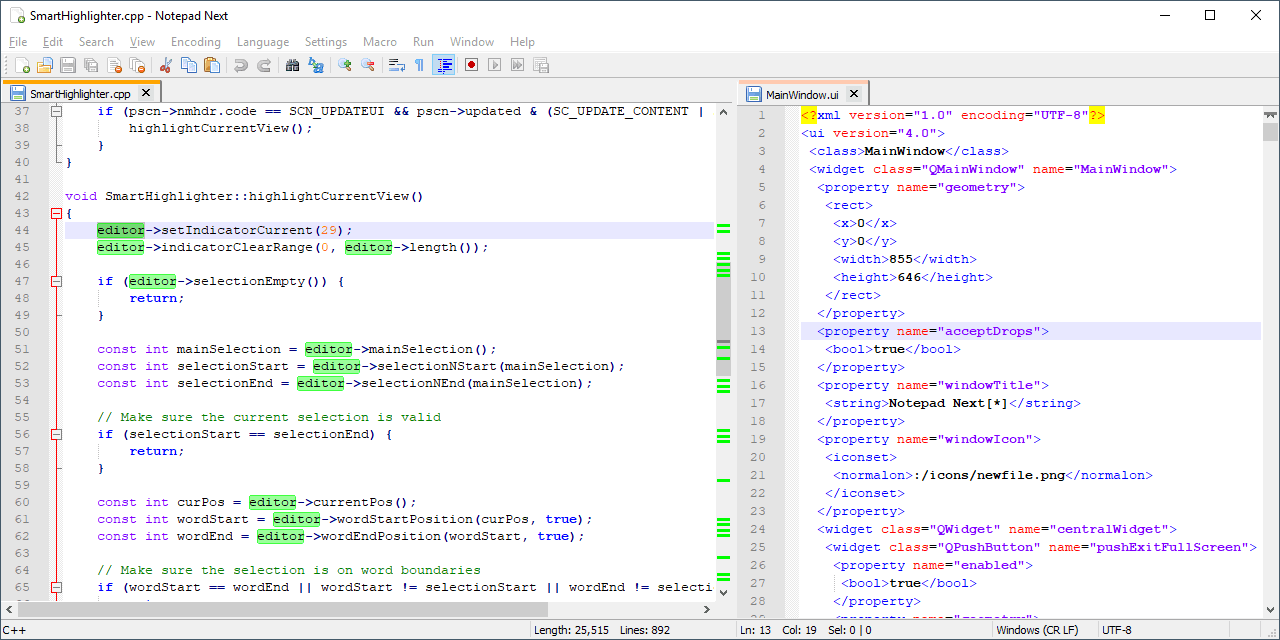
NotepadNext is a cross‑platform reimplementation of Notepad++.

Implemented in C++, NotepadNext brings the familiar Notepad++ editing experience to macOS and Linux, aiming for feature parity while using modern toolkits for native look and feel. The source is available on GitHub.

You’re all caught up.

28 stories from 221 scanned overnight.

archived edition · 221 fetched → 28 publishedj/k move · enter expand · o open · / search