Codeforces Div. 3 ICPC contest runs for 2.5 hours, starting Monday 21 Sep at 14:35 UTC.
- Mon 21 Sep 14:35 UTC
- 2.5h
The contest is open to all participants, follows the standard Codeforces format, and provides a live scoreboard for real‑time ranking.
You’re reading an archived edition. Today’s is here →
Codeforces Div. 3 ICPC contest runs for 2.5 hours, starting Monday 21 Sep at 14:35 UTC.
The contest is open to all participants, follows the standard Codeforces format, and provides a live scoreboard for real‑time ranking.
A Hackaday tutorial shows how to write a Bluetooth thermal‑printer driver for the ESP32‑C3 to print sensor‑data reports.
The two‑part guide walks through ESP‑IDF setup, Bluetooth SPP communication, and driver integration, enabling portable IoT devices to produce on‑the‑fly hard‑copy logs.

OpenArch is a collection of PyTorch implementations covering modern large language model architectures, shared on Hacker News.
The repo provides reference code for transformer variants such as GPT‑style and encoder‑decoder models, facilitating research prototyping and educational use.

Distributed Systems Classics (2017) is a curated list of seminal papers and books on distributed systems shared on Hacker News.
The collection covers foundational topics such as consensus algorithms, fault tolerance, and scalability, serving as a reference for students and researchers alike.
Fyxer builds an AI executive assistant that organizes inboxes and drafts emails in each user’s voice using OpenAI models, fine‑tuning, memory, and real user feedback.
The system integrates with common email providers, leverages GPT‑4‑class models for natural‑language generation, and continuously improves through iterative user corrections to increase trustworthiness.

OpenArch is a collection of PyTorch implementations covering modern large language model architectures, shared on Hacker News.
The repo provides reference code for transformer variants such as GPT‑style and encoder‑decoder models, facilitating research prototyping and educational use.
Fyxer builds an AI executive assistant that organizes inboxes and drafts emails in each user’s voice using OpenAI models, fine‑tuning, memory, and real user feedback.
The system integrates with common email providers, leverages GPT‑4‑class models for natural‑language generation, and continuously improves through iterative user corrections to increase trustworthiness.
Tencent’s AuK is a text‑to‑speech model on Hugging Face that has been downloaded 1,928 times and received 230 likes.
AuK targets Mandarin speech synthesis and is maintained by the community; it can be fine‑tuned for specific voice characteristics and is available under a permissive license.

A Hackaday tutorial shows how to write a Bluetooth thermal‑printer driver for the ESP32‑C3 to print sensor‑data reports.
The two‑part guide walks through ESP‑IDF setup, Bluetooth SPP communication, and driver integration, enabling portable IoT devices to produce on‑the‑fly hard‑copy logs.
LWN reports Monday’s security updates across AlmaLinux, Debian, and Fedora, covering dozens of packages such as kernel, nginx, nodejs, and openssl.
The updates address multiple CVEs and stability issues; administrators are urged to apply the patches promptly to maintain system security.
An incomplete fix for CVE‑2024‑53920 leaves Emacs 24 and newer vulnerable to arbitrary code execution when opening untrusted files in non‑Lisp modes; a minimal fix is slated for Emacs 31.2.
The original patch missed handlers for several file modes, allowing code execution; upstream does not plan backports, so users should upgrade to 31.2 or apply the provided interim patch.
GNU coreutils 9.12 was released, incorporating 288 commits from 16 contributors over 21 weeks since 9.11, adding an –A option to uname and filesystem‑type awareness to stat and tail.
The release also fixes a long‑standing bug that caused utilities to fail when traversing directories while files were removed in parallel, improving robustness.
The latest batch of seven Linux stable kernels (7.2.6 to 5.10.270) contains over 9,000 patches in total, with more than 1,800 patches applied to 7.2.6 alone.
This volume may set a record for stable‑kernel patch counts; users are advised to upgrade to benefit from security fixes and performance improvements.
Former Debian Project Leader Andreas Tille, after serving two consecutive terms and stepping down in 2024, shared lessons learned and discussed Debian’s stance on large language model usage.
Tille reflected on initiatives he led, mistakes made, and the upcoming General Resolution concerning LLM integration in Debian infrastructure.
Codeforces Div. 3 ICPC contest runs for 2.5 hours, starting Monday 21 Sep at 14:35 UTC.
The contest is open to all participants, follows the standard Codeforces format, and provides a live scoreboard for real‑time ranking.
Distributed Systems Classics (2017) is a curated list of seminal papers and books on distributed systems shared on Hacker News.
The collection covers foundational topics such as consensus algorithms, fault tolerance, and scalability, serving as a reference for students and researchers alike.
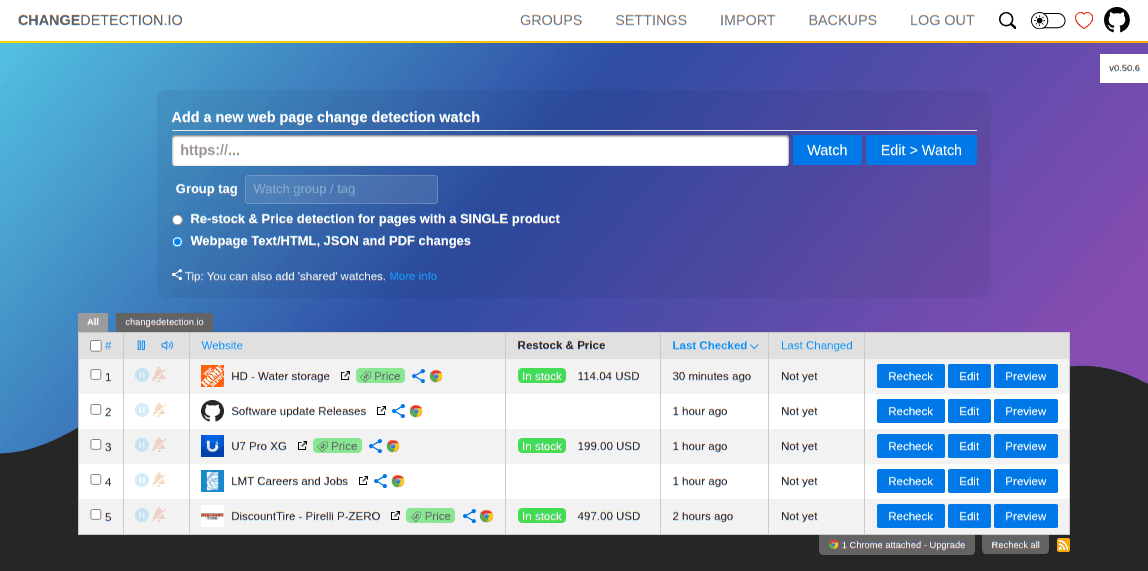
changedetection.io is a Python tool for monitoring website changes, offering free alerts and a SaaS plan for advanced use.
It detects content updates, price drops, restocks, and defacements, and can be deployed via Docker or run locally from the command line.
A Rust userspace implementation of the WARP core that enables censored network access via MASQUE over HTTP/3 and HTTP/2.
Running in userspace avoids kernel modifications, while Rust provides memory safety. MASQUE leverages HTTP/3's multiplexing to tunnel traffic, improving latency compared to older proxies. The project targets environments where traditional VPNs are blocked, offering a lightweight alternative for developers and activists.

Project NOMAD provides an offline‑first server delivering Wikipedia, thousands of books, courses, maps, and optional local AI on personal hardware without internet connectivity.
All content is stored locally, enabling use in remote or censored regions. The system syncs updates when a connection is available, then operates independently. Optional AI modules run entirely on‑device, preserving privacy while offering interactive assistance. It is designed for educational institutions and field deployments.

VoxCPM2 is a tokenizer‑free text‑to‑speech system capable of multilingual speech generation, creative voice design, and realistic voice cloning.
By omitting a separate tokenizer, the model processes raw text directly, reducing preprocessing overhead. It supports dozens of languages in a single model, simplifying deployment across regions. The architecture enables fine‑grained voice style control, useful for game audio, dubbing, and personalized assistants. Open‑source releases include pretrained checkpoints for rapid experimentation.

OpenTTD is an open‑source simulation game that recreates the gameplay of Transport Tycoon Deluxe.
The project extends the original 1994 game with modern features such as multiplayer, custom maps, and extensive mod support. It runs on Windows, macOS, Linux, and browsers via WebAssembly. Community contributions continuously add new vehicles, industries, and scenarios, keeping the simulation relevant for both nostalgic players and new audiences.

OpenResearch lets developers convert their coding agents into autonomous research agents.
The framework provides APIs for agents to retrieve papers, extract data, and generate summaries without human intervention. It integrates with popular code repositories and citation databases, enabling continuous literature monitoring. By automating routine research tasks, it aims to accelerate hypothesis testing and keep teams up‑to‑date with emerging findings.

17 stories from 158 scanned overnight.
Get it every morning: RSS feed.